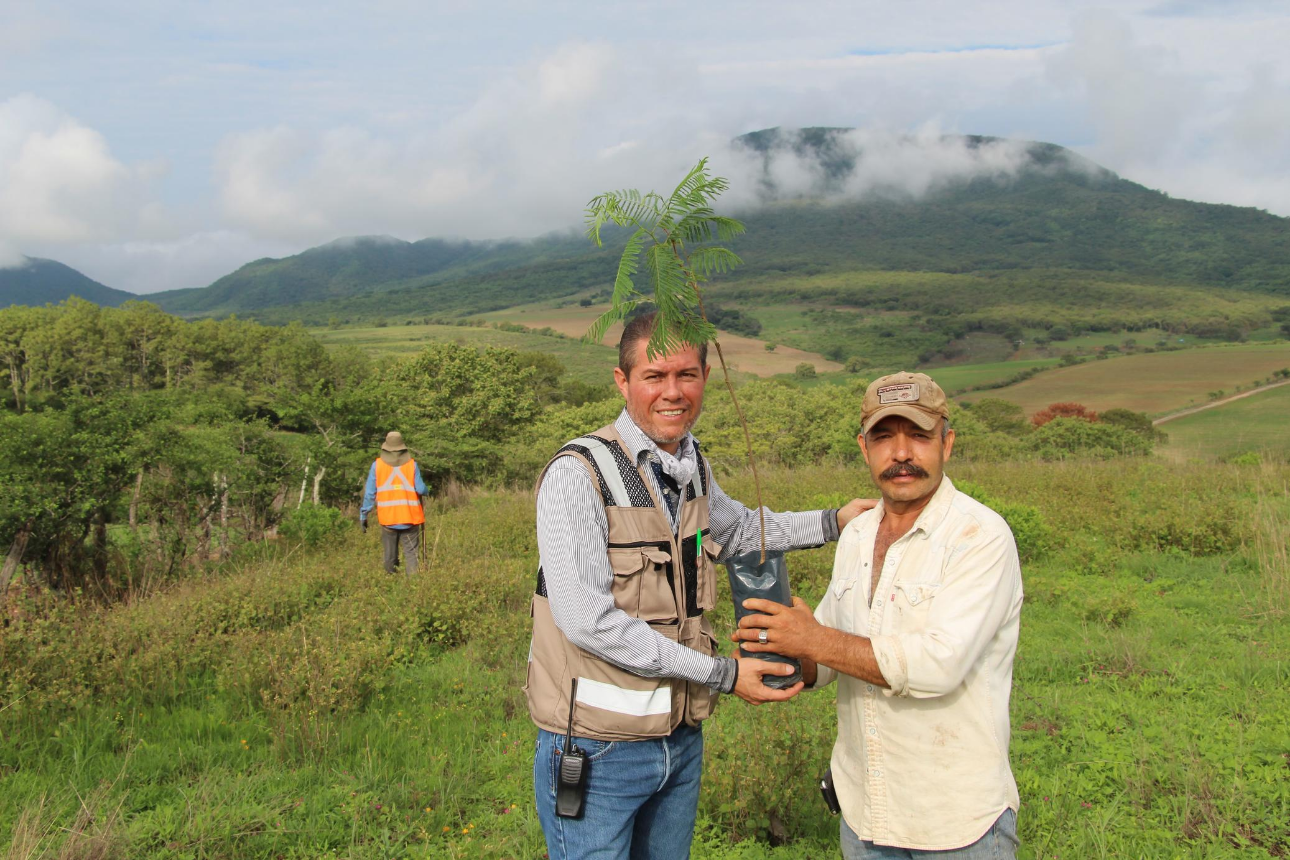
Our exploration team in Mexico has several initiatives in place to minimize its environmental footprint. Wherever possible, no new roads are built. Instead, old roads are rehabilitated, and drilling sites are accessed by foot.
The arrival of an exploration team in a community is often the first contact local residents have with a mining company. It is also the first step to building trusting and positive relationships, which are key to gaining and maintaining our social license to explore, and potentially to operate a mine in the region.
That is why, from the onset of our exploration work, Agnico Eagle’s geologists focus on understanding and being respectful of the needs of the community and the local environment.
According to Guy Gosselin, Agnico Eagle’s Senior Vice-President of Exploration, “Maintaining our social license is a key element of achieving Agnico Eagle’s business objectives. That license depends on our ability to respect our environmental and social commitments, and build strong, mutually beneficial relationships with our many stakeholders. Our exploration teams work hard to be good neighbours and meet the expectations of communities near our exploration sites.”
In Nunavut, for example, which is a vast and remote territory, our geologists explore the landscape mainly using helicopters, as do other organizations in the region. This can create extensive air traffic, which could lead to potential disturbances. Our Nunavut exploration team uses radio announcements and our local Facebook pages to inform communities of helicopter movements and other exploration activities. The team also ensures all proper procedures are followed to minimize potential disturbances to natural habitats, animals or residents. Any complaints that we receive are investigated and acted upon as quickly as possible.
The team is also implementing a land-use mapping project to enhance the sharing of information about access to the territory for pleasure boat users, hunters, fishermen, and trappers. The map highlights protected areas that must be avoided at all times.
In Mexico, respect for the environment and communities goes hand in hand with our exploration work. Our goal is to generate minimum impact on the environment and respect local community customs, while simultaneously generating maximum social and economic benefits.
Our Mexican exploration team has several initiatives in place to minimize its environmental footprint:
– Minimizing the impact of drilling activities: Priority is given to using portable and compact equipment to work in small areas in order to minimize vegetation clearing and soil removal. Wherever possible, no new roads are built. Instead, old roads are rehabilitated, and drilling sites are accessed by foot.
– Preserving natural resources: Rainwater collection systems for domestic use are installed at our exploration camps to meet, as much as possible, the camp’s water needs and reduce the need to search for local water resources. Additionally, any water used for drilling activities is decanted and reused, reducing overall water consumption. Our camps use solar energy systems for lighting.
– Integrating biodiversity conservation: We monitor the wildlife that moves within our project areas to ensure conservation and protection. Wildlife is rescued and relocated when personnel or wildlife are endangered. In 2019, we relocated 15 animals of different species to other areas.
– Promoting re-vegetation efforts and education: Since 2017, 6,000 trees have been planted in communities near our exploration projects. We involve youth in these activities, highlighting the importance of trees in their environment. We donated 3,000 tree plants of native species, produced in our nursery, to local farmers who use them as natural fences to protect their crops.